
Electrons with a conscience

One of the more pleasant surprises to me about the neighborhood solar campaign I’ve been tracking this winter is the philanthropic aspect of it. The local installation and manufacturing companies involved have voluntarily sliced into their profit-margins to support the community-strengthening work of three nonprofit organizations.

First, and perhaps most impressively, the campaign raised $10,101 for American Red Cross disaster relief. This financial boost came from sales of solar panel arrays during part of the campaign (through December 31, 2012).
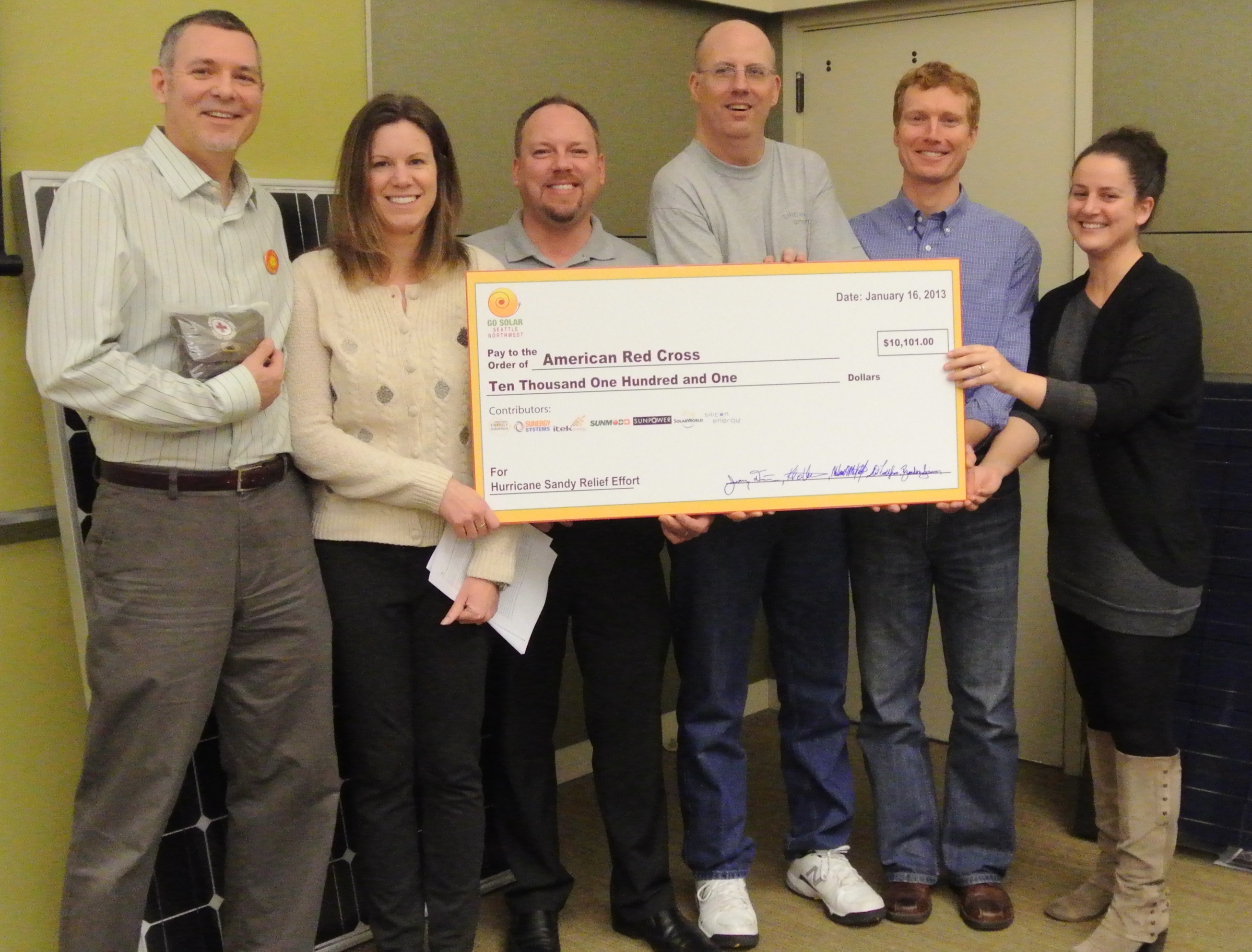
Photo of people standing behind large donation check

From left to right: Joe Deets of Community Energy Solutions, Ann Bodden of the American Red Cross, Brandon Gwinner of Sunmodo Corp., Stu Frothingham of Silicon Energy, Karl Unterschuetz of Itek Energy, and Melissa Metcalfe of Sunergy Systems

Bodden is particularly grateful to Joe and Tammy Deets, who saw a connection between the Hurricane Sandy disaster and climate change: “Joe and Tammy did an amazing job of rallying the manufacturers they work with to help raise over $10,000 for American Red Cross disaster relief. They were motivated and enthusiastic about helping the American Red Cross raise funds following Superstorm Sandy.”

Second, the Go Solar Seattle Northwest campaign is carving out $150 of each sale in Ballard territory to go to Sustainable Ballard. At this writing, 10 systems have been sold in zip codes 98107 and parts of 98117, amounting to $1,500. That’s no small change for a nonprofit community and environmental group that runs solely on volunteer power!

And finally, the organizers of the campaign, Community Energy Solutions, are themselves a nonprofit, whose mission is to “bring energy solutions to Main Street by being a catalyst for communities.” The sales from this particularly successful campaign will no doubt help them continue their catalyzing efforts. Up next: an energy efficiency workshop in Issaquah, where they will present information about combining home energy efficiency measures with solar power for optimal savings.
How to make installing solar more affordable

The up-front cost of installing a solar array on the roof of a home has often been cited as a barrier to entry for an ordinary homeowner. But now financing the system is pretty common, whether through a leasing arrangement or a low-interest loan. And when you can “go solar” for hardly any money down, all of a sudden it isn’t hard to imagine neighborhoods dotted with paneled rooftops.

Puget Sound Cooperative Credit Union (PSCCU) is offering low-interest loans to cover up to $35,000 of the cost of installations purchased through the Go Solar Seattle Northwest campaign. This means in most cases you can get those panels up and producing juice for you without putting a dent in your savings.

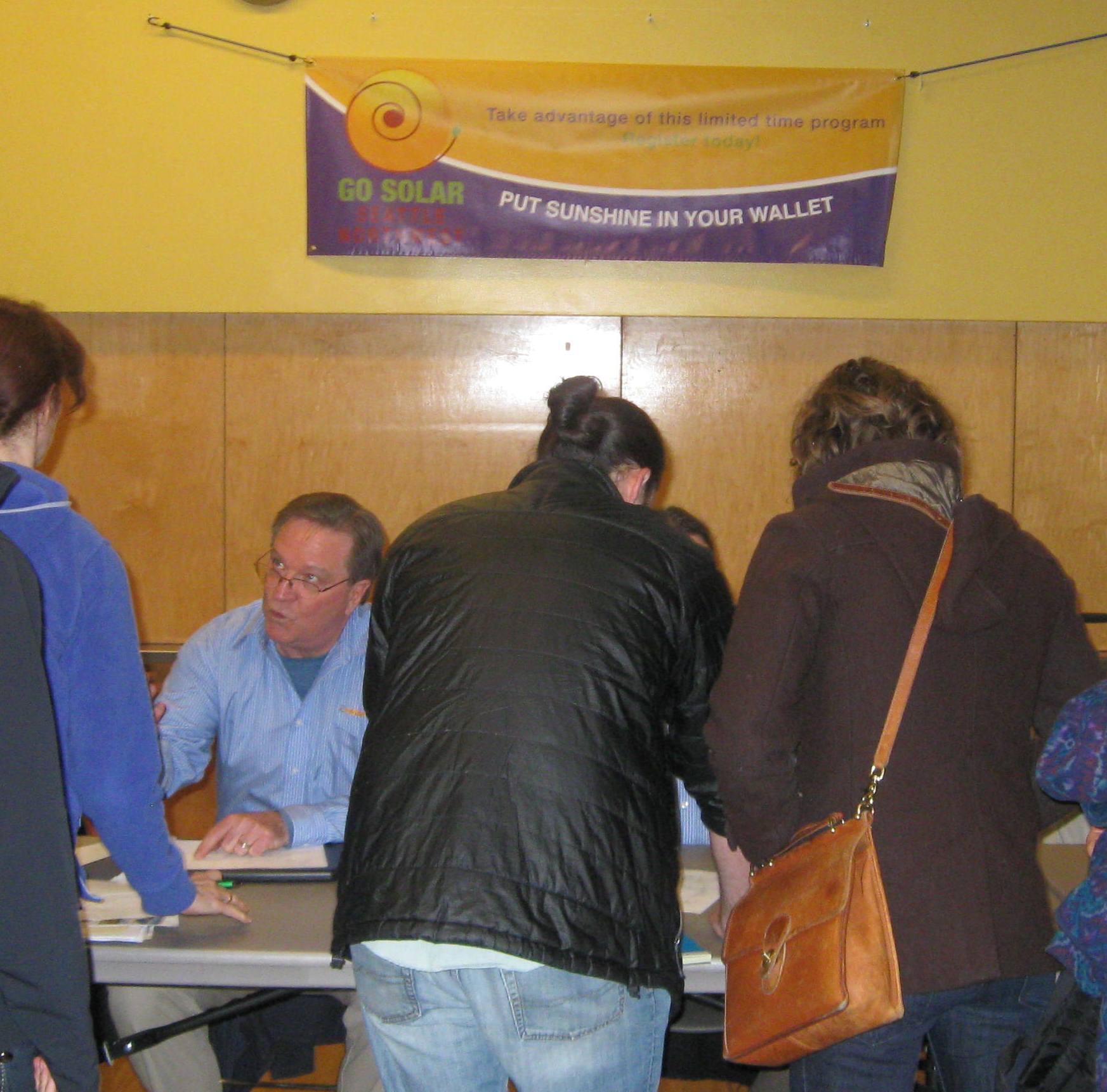
Photo of people signing up for solar site assessment

Attendees at a Go Solar Seattle Northwest workshop in December sign up for a free site assessment from Sunergy.

For example, say you’ve got a moderate-sized home, and after consulting with a solar professional, you’ve determined that you want a system that costs $20,000 total. You’ve planned ahead a little, so you can afford to pay for half the system when it is installed, but you’ll need to finance the rest of it.

You go see one of the loan officers at PSCCU, and because you’ve got a respectable credit rating, they can offer you a $10,000 loan at 5 percent interest. You can pay off the balance of the loan over a leisurely 15-year period if you like.

The really cool thing for you as a borrower is that that new solar array on your house isn’t just sitting around doing nothing; it is working on your behalf, every day (or nearly every day), creating value as power that you can use yourself or sell back to the utility. State of Washington incentives are structured such that if you buy in-state solar panels and inverters, you can realize a 10 percent per year return on investment.
The cost of money from the credit union is easily offset by the return from the solar installation itself.
In other words, the cost of money from the credit union (4.49-7.99 percent) is easily offset by the return from the solar installation itself (approximately 10 percent).

Shannon Ellis-Brock, Chief Operating Officer of PSCCU, says the loans make good business sense for the credit union as well: “Our small credit union was just given an award for being 5th in loan growth for all US credit unions in 2012. This was in large part from growth in Energy Smart loans (which include solar) and our commitment to offering Washington homeowners a way to finance green projects.”

But for Ellis-Brock, the reason for partnering with a program like Go Solar Seattle Northwest goes beyond just dollars and cents. “Credit unions were founded on the principle of people helping people – we have expanded on the principle and not only are we helping people, we’re helping the environment, helping to reduce our reliance on foreign fuels, and making use of an energy supply that is free and will be around forever,” she added.

This combination of long-term idealism and here-and-now pragmatism is a healthy sign of a maturing renewable energy movement. Bankers absolutely have their role to play in this. As Danny Kennedy writes in Rooftop Revolution (2012): “Financial engineering allows you to pay for your solar panels over time instead of up front, and this is probably the most important innovation in the solar industry in the past decade” (p. 99).

The “Go Solar Seattle Northwest” campaign

Savvy homeowners are beginning to shop around for something a little unexpected: energy. No longer strictly the purview of big utility companies or off-grid eccentrics, rooftop solar arrays are becoming more of a mainstream home improvement option for ordinary consumers.

Though costs have come down, and state and federal incentives help sweeten the pot, a typical installation is still a five-figure affair ($15,000 – $30,000), roughly similar to buying a new car. “Shoppers” in this new market will want to proceed deliberately, do their homework, and not have to contend with a high-pressure pitch from some showroom salesman.

And that’s precisely what’s so refreshing about what’s going on in some Seattle neighborhoods right now. The Go Solar Seattle Northwest campaign is a collaboration among two non-profit groups, Community Energy Solutions and Sustainable Ballard, a local solar panel installation company, Sunergy Systems, and other key partners. And it’s hitting just the right note with homeowners who are curious about going solar.

The campaign is primarily organized around four free workshops, presented on neutral ground at places like the Ballard Public Library and Phinney Neighborhood Center. At the two that I’ve attended so far, small groups of 20-30 program registrants listen attentively to a straightforward, factual, friendly presentation from Joe Deets of Community Energy Solutions and Howard Lamb of Sunergy. The audiences are ready with intelligent questions, and aren’t shy to ask them at any point during the 90-minute session: how quickly can I see a return on investment? How will this affect the integrity of my roof? What do I have to do to clean and maintain the modules?
Rooftop solar arrays are becoming a mainstream home improvement option for ordinary consumers.
For Deets, taking a collaborative approach to this campaign made sense on a number of levels. “It was only natural that we approach Sunergy Systems as the installer. Sunergy is the largest solar installer in Washington, they have an excellent reputation, and couldn’t be more local, with their office right in Ballard. They recommended that we talk with Jenny Heins of Sustainable Ballard as another partner. Jenny knows everyone, and has really helped us get the word out. We are thrilled to have such excellent partners in this campaign.”

Indeed, the project dovetails seamlessly with the mission of Sustainable Ballard, which was originally formed in 2003 with energy independence as part of its core philosophy. In return for its grassroots expertise and neighborhood communications efforts, Heins said that the non-profit receives $150 for every sale.

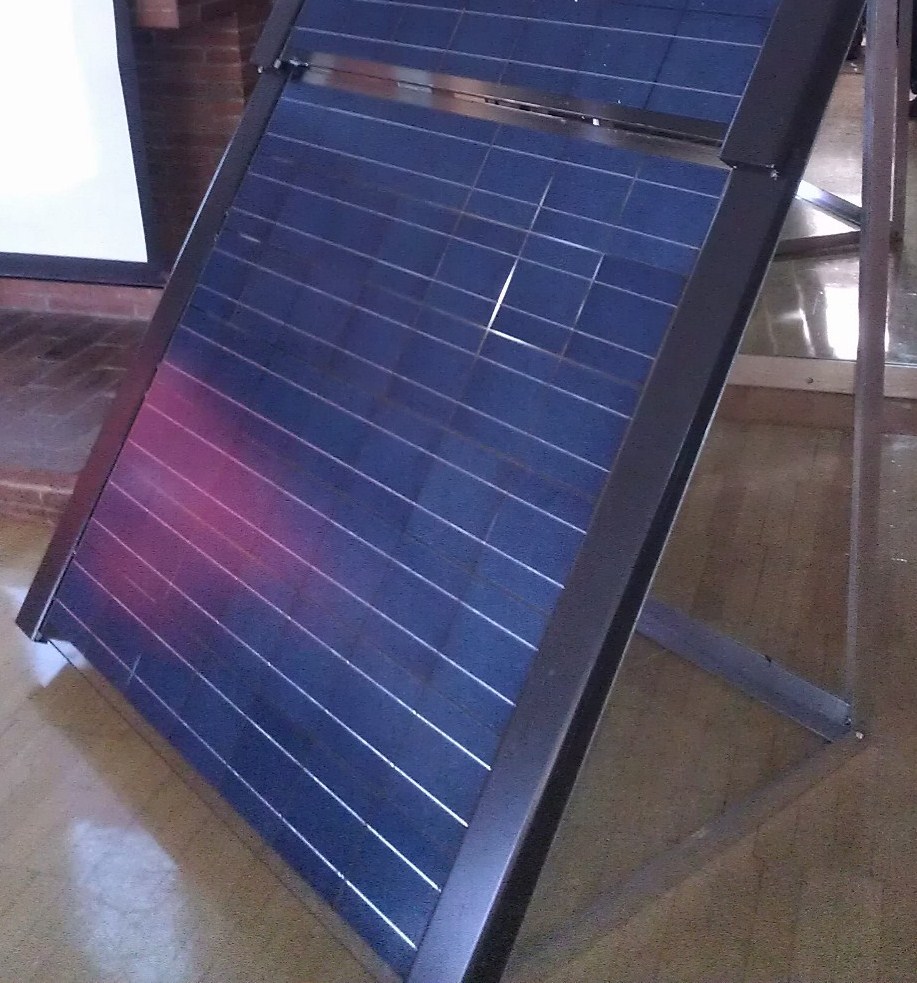
And rounding out the collaborative effort is Silicon Energy, a module manufacturing company in western Washington. Registrants may select from four different module manufacturers, but Stu Frothingham of Silicon Energy is always on hand at the workshops to answer questions, and may even invite you to hop up and down on the world’s most durable module!

Photo of solar panel

Silicon Energy module on display at one of the workshops.

Though internationally the solar industry is robust and mature, here in the US it really does feel like an emerging sector, very small-scale still. For this reason, highly collaborative efforts such as the Go Solar Seattle Northwest campaign and others similar to it, may be exactly the right model for disseminating information and connecting small, local businesses to a potentially enthusiastic customer base.